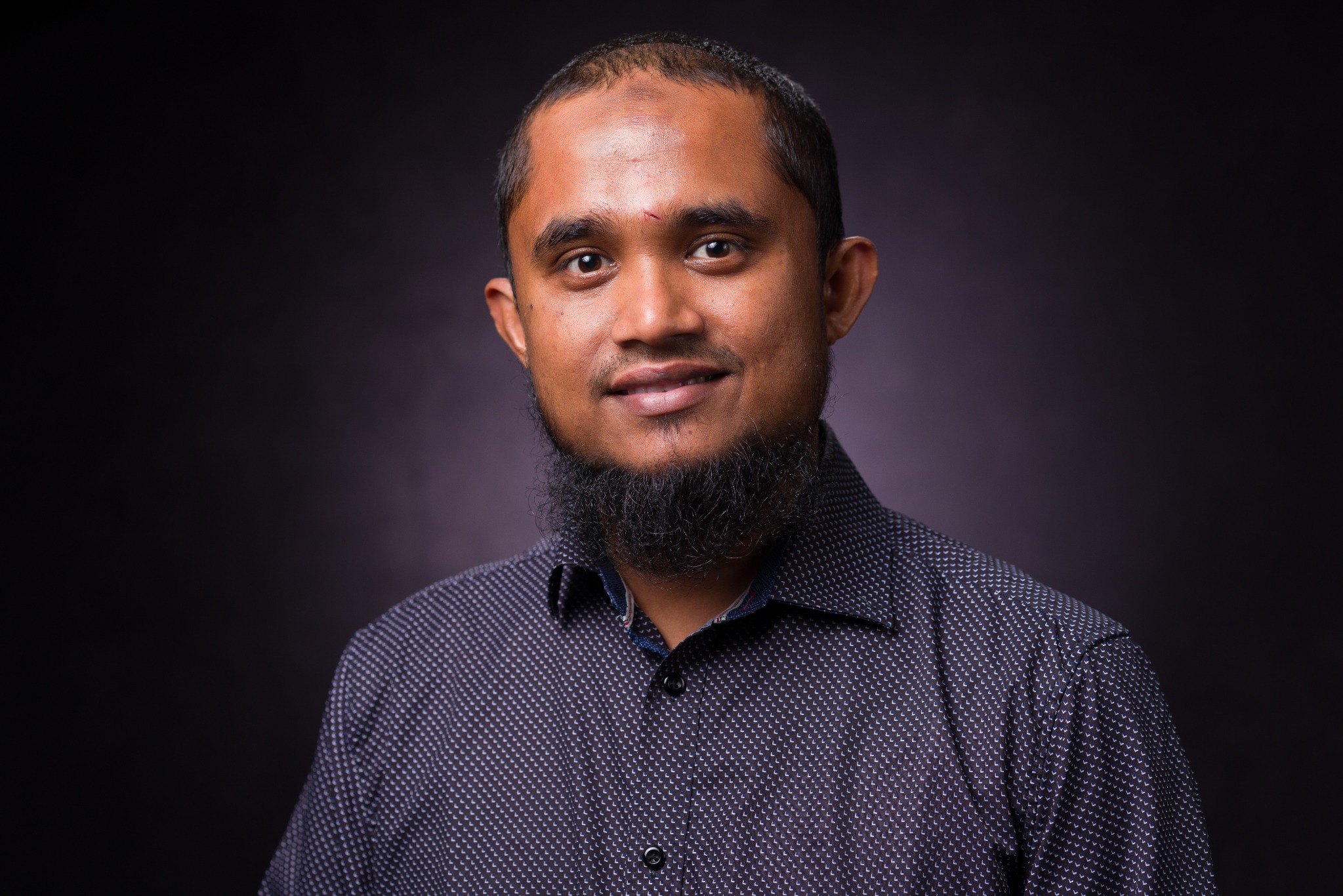
Shakil Ahmed, Ph.D.
Tenure-Track Assistant Professor of Quantum Computing
Department of Computer Science,
College of Computing
Grand Valley State University, Michigan, USA
Affiliate Assistant Professor
Department of Electrical and Computer Engineering
Iowa State University, Iowa, USA
Office:
CHS 160 — Cook-DeVos Center for Health Sciences
301 Michigan St NE,
Grand Rapids, MI 49503
Email:
[email protected]
Phone:
616-331-2733
Education:
PhD in Computer and Electrical (co-major) Engineering, Iowa State University
MS in Computer Engineering, Utah State University
BS in Electrical and Electronic Engineering, KUET, Bangladesh
Biography
Dr. Shakil Ahmed is an Assistant Professor of Quantum Computing in the Department of Computer Science, College of Computing, Grand Valley State University, and an Affiliate Assistant Professor in the Department of Electrical and Computer Engineering at Iowa State University, Ames, Iowa. He directs the Q-NNECT Lab, where the work centers on protocol design for quantum networks — and on one question underneath it: how do you move information reliably across a network that is never quite good enough?
His training was built for that question. After a background in electrical and electronic engineering, he earned a Master of Science with co-majors in Computer Engineering and Electrical Engineering at Utah State University, working on physical layer security for 5G — treating the wireless channel itself as a security mechanism rather than something bolted on afterward. He completed his PhD at Iowa State University in December 2023, again with co-majors in Computer Engineering and Electrical Engineering, finishing in two years and eight months.
The years that followed built a deep classical foundation: reconfigurable intelligent surfaces and massive MIMO, ultra-reliable low-latency communication, digital twins, edge computing, radio resource management, and the Tactile Internet, where a surgeon's hand and a robot's response must stay within milliseconds of each other. The tools were reinforcement learning and deep RL, federated learning, stochastic modeling, optimization, and network simulation at scale. That work continues, and it is what makes the rest of this tractable.
Classical networks, though, are meeting limits that better engineering cannot remove. Spectrum is finite. Latency has a floor. And the cryptography protecting today's traffic has an expiration date that quantum computing keeps moving closer. Quantum networking is the response — and it is a genuinely strange medium to build in. Entanglement is not a packet: it decays, it cannot be copied, and it arrives probabilistically rather than on demand. Links fail in ways classical protocols were never written to express, and a stack that assumes retransmission, buffering, and copyable state has to be rebuilt from its assumptions upward.
But the questions asked of that medium are the ones he has always asked. How do you route under uncertainty? How do you allocate a scarce resource fairly? How do you build reliability out of unreliable parts, and put security in the physical layer rather than on top of it? He did not change fields when he moved to quantum — the field moved, and the question came with it.
Quantum networking is now the center of the program. The lab works on quantum-aware protocol stacks and OSI redesign for quantum-native and hybrid networks, entanglement routing under fidelity and memory-lifetime constraints, classical–quantum control planes in which conventional signaling schedules quantum operations, entanglement generation and fidelity optimization over RIS-assisted THz links, and quantum-driven security for the Tactile Internet. This work appears in IEEE INFOCOM, IEEE GLOBECOM, IEEE Transactions on Quantum Engineering, Advanced Quantum Technologies, and Sensors.
A second thread runs through all of it: quantum machine learning used as protocol machinery, not as a wrapper around it. Variational circuits are interesting here for a structural reason — a node already holding quantum state can evaluate a policy where that state lives, rather than measuring it back to classical first and paying for the collapse. The lab has applied variational quantum control to zero-trust enforcement on Tactile Internet traffic, variational encoding to noise-aware stabilization in RIS-aided links, quantum neural networks to dynamic anomaly detection in 7G security frameworks, and quantum-enhanced constructions to lightweight authentication for vehicular networks. The discipline is in asking each time whether the quantum model earns its cost under NISQ-era circuit depth, shot budgets, and trainability limits — and reporting honestly when it does not. He serves on the program committee for the NeurIPS Workshop on Secure and Trustworthy Quantum Machine Learning.
He advises PhD, master's, and undergraduate researchers working directly on these problems — entanglement distribution, protocol design, network architecture optimization, and quantum machine learning — having supervised the lab's first PhD graduate and mentored students who have gone on to national fellowships and industry research positions. Students are not assistants on this work; they are where much of it originates. He brings undergraduates into quantum research early, while the field is still open enough that a well-posed question from a new researcher can matter.
Dr. Ahmed's work is deliberately interdisciplinary, with collaborations spanning control and robotics, biomedical and circuit design, veterinary medicine, economics, packaging, and medicine. He serves as a Guest Editor at Sensors for the special issues “Quantum-Enhanced Wireless Communication: Recent Advances in MIMO Systems and Networking” (Link) and “Transmission Control Protocol (TCP) in Wireless and Wired Networks” (Link), and as a technical reviewer for Advanced Quantum Technologies.
In the classroom he uses project-based and team-based learning to give undergraduate and graduate students problems that resemble the ones they will actually meet, and integrates generative AI tools to support students working through complex coding and problem-solving tasks.
Research Interests
Protocol design for quantum networks — what the network stack becomes when the payload is entanglement, and it cannot be copied, buffered indefinitely, or retransmitted on demand — together with the quantum learning methods that make decisions inside that stack.
- Quantum-aware protocol stacks — what layering, addressing, and service abstraction mean once the link layer produces entanglement probabilistically rather than moving bits. Which classical abstractions survive translation, which quietly mislead, and which have no quantum analogue at all.
- Entanglement routing and resource allocation — path selection under decoherence deadlines; swapping and purification policy; memory allocation and cutoff timing; contention when many requests compete for one shared entanglement supply.
- Quantum machine learning inside the protocol — variational circuits as control and decision policy rather than a classifier bolted on the side: VQC-based zero-trust enforcement, variational encoding for noise-aware link stabilization, quantum neural networks for anomaly detection, and hybrid training loops that respect NISQ circuit depth, shot budgets, and trainability. Where a classical model is cheaper and just as good, we use the classical model.
- Reliability and fidelity management — fidelity as a first-class QoS metric rather than a hardware footnote. Assembling end-to-end guarantees from probabilistic links, and deciding when to purify, when to re-attempt, and when to fail fast.
- Classical–quantum control planes — the classical signaling, synchronization, and scheduling every quantum network depends on, designed so quantum links deploy alongside existing infrastructure rather than requiring a parallel one.
- Security designed into the stack — zero-trust architectures and lightweight authentication built into quantum-aware protocols from the start, extending the physical layer security work that preceded them.
- The physical substrate — RIS-assisted and THz links as carriers for entanglement generation and distribution, and the joint optimization of generation rate against fidelity under real channel impairments.
Join the Lab
The Q-NNECT Lab is recruiting at every level — postdoctoral researchers, PhD and master's students, and undergraduates — to work on protocol design for quantum networks and quantum machine learning for network control and security.
There is a current opening in Quantum Tactile Networks Simulation for GVSU juniors, seniors, and master's students, and I will be teaching Introduction to Quantum Computing in Winter 2027 for anyone who wants a way in before committing to research.